Skip to content
Cape Braai

Firewood at the Cape

Which wood for the braai and the fireplace?

Four woods sit on practically every shelf in Cape Town — and they are not interchangeable. One is a protected species, two are invasive, and only two are any good in a fireplace. Here is what goes where.

The quick comparison

Heat and coal life as comparative values from 1 to 5, not measurements. Sources are listed with each wood.

WoodHeatCoal lifeBraaiFireplaceSmoke
Rooikrans 4/5 3/5 yes no spicy, resinous
Sekelbos 5/5 4/5 yes no sweet, aromatic
Kameeldoring 5/5 5/5 yes yes subtle, dry
Black Wattle 3/5 4/5 yes yes smoky, assertive
Invasive — burning it helps Braai

Rooikrans

Acacia cyclops

The Western Cape default. Quick to temperature, very hot coals that fade sooner than the denser woods.

Rooikrans is what most braais at the Cape run on, for a practical reason: after roughly 40 minutes you have coals hot enough for wors and chops. They do not last forever, though — perfect for a 45-to-60-minute braai, wrong for a three-hour potjie.

The acacia originally comes from Australia and has spread along the coast to the point of crowding out indigenous fynbos. Burning rooikrans is, in that sense, conservation work with dinner as a side effect.

Buying it

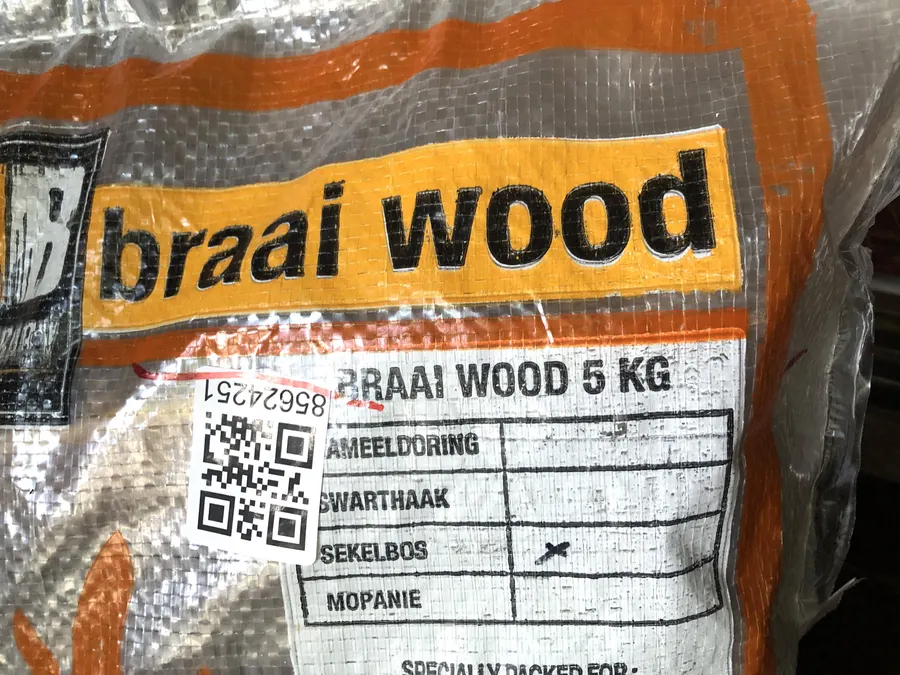
Sold in supermarkets as "Bush Baby Rooikrans" in 7 kg bags; cheaper per kilo from firewood merchants, especially if you buy split logs by the bag rather than pre-packed.
Sources
Unproblematic Braai

Sekelbos

Dichrostachys cinerea

The driest firewood you can buy — moisture content near zero. Very high heat and smoke that works like a spice.

Sekelbos is traded less as fuel than as flavour. The wood dries down in the bushveld sun to a moisture content between zero and one percent and carries aromatic oils that release a distinctly sweet smoke as it burns.

That makes it the opposite of a neutral wood. Sear a steak quickly and you will barely notice. Keep poultry or pork belly over the coals for longer and the difference is obvious.

Buying it

Pricier than rooikrans and not stocked everywhere. Worth it for longer cooks — on quick wors the aroma is wasted.

Sources
Protected species — check the origin Braai Fireplace

Kameeldoring

Vachellia erioloba

Rock-hard, extremely dense, burns for hours with a calm flame and little smoke. Southern Africa's best fireplace wood — and the legally trickiest.

Kameeldoring is the benchmark other firewood is measured against: dense, heavy, near bone-dry, with a flame that stands still and coals that carry for hours. In a fireplace that means loading once instead of feeding constantly, and barely any smoke in the room.

The catch is legal. The tree grows extremely slowly and is listed as a protected species under South Africa's National Forests Act. Cutting living trees without a permit is an offence. What is legally on the market almost always comes from Namibia, where camel thorn is farmed for the purpose, or from demonstrably dead trees.

Buying it

Only buy from a merchant who states the origin — "Namibian Kameeldoring" is the usual marker for legal stock. Suspiciously cheap wood at the roadside: walk away.

Sources
Invasive — burning it helps Braai Fireplace

Black Wattle

Acacia mearnsii

Softer than the other hardwoods, but cheap, available everywhere, and good for long, even coals.

Black wattle is the workhorse. It is softer than rooikrans or kameeldoring, so it catches faster and lights a fire well — yet it holds a surprisingly long, even bed of coals and gives meat a pronounced smoky note.

This acacia is introduced too and counts as invasive in South Africa because it draws enormous amounts of water along riverbanks. Burning it is as uncontroversial as burning rooikrans.

Buying it

The cheapest of the four. If you are unsure where to start: here — with a bag of rooikrans alongside.

Sources

Where to get it

In supermarkets, Shoprite and Checkers stock the Bush Baby bags — 7 kg of rooikrans for an ordinary braai, 16 kg mixed for a long evening. If you braai often, buy from a firewood merchant instead: Cape Town Firewood, Mother City Firewood and The Wood Gurus all deliver in the city, and the price per kilo is well below supermarket level. They carry kameeldoring too — but only buy it with a stated origin.

A retail bag of braai wood, labelled with the wood types it contains
Ossewa · CC BY 4.0