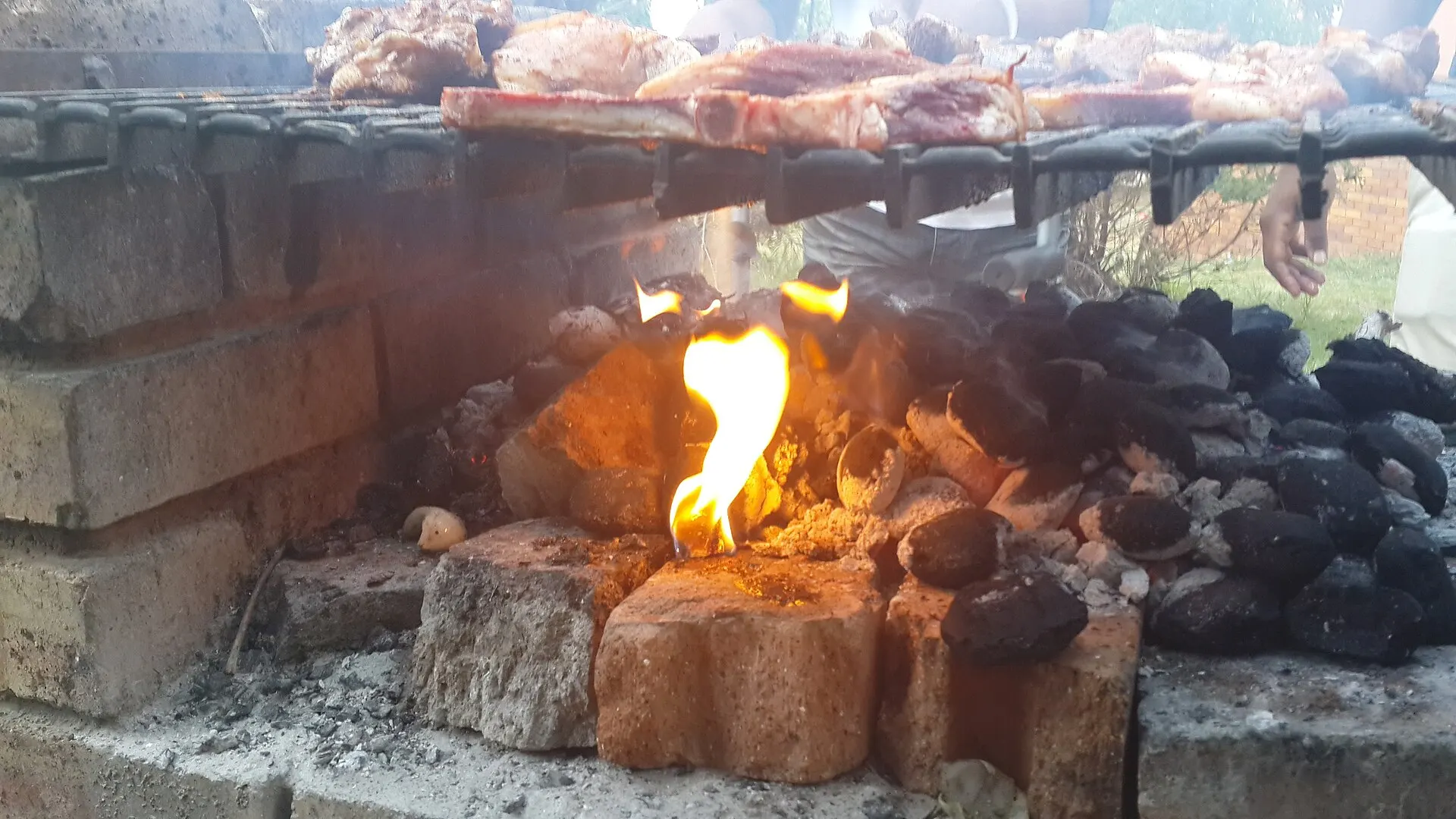
From lighting up to coals
The fire, not the grill
The difference between a braai and a barbecue is not the food, it is the hour beforehand. Wood is burned down until only coals remain — and those coals are read, not measured.
The sequence
Four steps, one hour
-
Build it
Kindling in the middle, heavy logs stacked loosely into a cone above it. Air has to travel up through the pile — a tightly packed heap burns badly and smokes.
-
Burn it down
The fire burns for 30 to 40 minutes. The point is not to have flames but to get rid of them. Nothing cooks over open flame — it blackens the outside and leaves the inside raw.
-
Wait for grey
The coals are ready when they are covered in a light grey layer of ash and glow red underneath. As long as black patches show, that part is still burning wood, not coal.
-
Spread them
Rake the coals to one side and leave the other clear. Those two zones are the actual tool: hot for searing, clear for cooking through.
Without a thermometer
The hand-over-grid test
Hold your open palm about ten centimetres above the grid and count slowly until the heat pulls you away. The number of seconds is the temperature — more accurate than it sounds, because it measures exactly what reaches the meat.
„Eight seconds for wors, six for tjops, four means wait."
How long can you hold it?
Full heat
Roughly 230 °C+You cannot hold your hand there for three seconds. This is the searing zone, not the cooking zone: hit the meat hard, then move it to the cooler side. Put a whole chicken here and you get charcoal outside, raw inside.
What it is for
Steaks, chops, tuna — anything that needs a crust
Hot
Roughly 200–230 °CThe working temperature for most meat. It browns quickly without the surface burning before the middle warms up. At four seconds the standing South African advice is still: wait a bit longer.
What it is for
Lamb chops, sosaties, thick sausages
Medium
Roughly 175–200 °CSix seconds is the call for chops. Anything that needs more than ten minutes belongs here — and fish always, because it dries out over full heat within minutes.
What it is for
Tjops, chicken pieces, fish in a hinged grid
Gentle
Roughly 150–175 °CEight seconds for wors — everyone at the Cape knows the rule. Sausage splits over strong heat and drops its fat into the fire. Bread and braaibroodjies only go on once the meat is off anyway.
What it is for
Boerewors, braaibroodjies, roosterkoek
What goes wrong
Four mistakes everyone makes
Starting too early
By far the most common one. While flames are still going, it is not a braai, it is a campfire with meat above it.
Using gas
Technically possible, culturally a statement. The smoke is half the seasoning — a gas grill gives you heat but no flavour.
Wet wood
Damp wood smokes bitter instead of aromatic and never gets to temperature. Logs should ring bright when knocked together, not sound dull.
Constant turning
Every turn costs crust, every prick costs juice. Once is enough for almost everything — for sausage it is mandatory.